




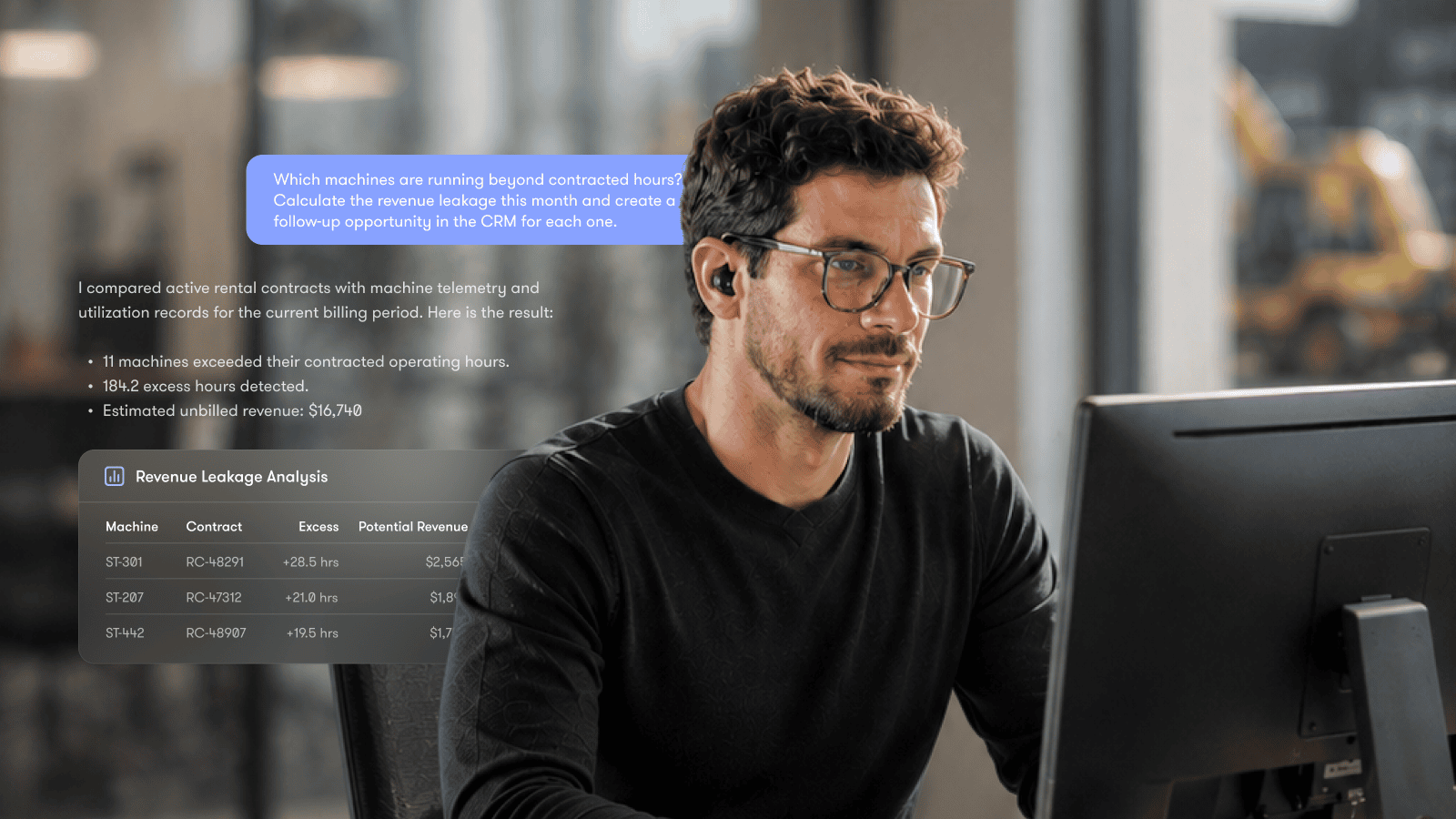
Historically, the instinct across rental has been the same. Bring every piece of operational data inside the business. That instinct is starting to rapidly evolve. The reason is MCP, a standard that barely existed two years ago.
My experience across three decades in this industry has shown that rental companies spend years building toward ownership. Their own data lake, their own pipelines, and their own people to maintain both.
When I ask why, the answer is usually some version of the same thing: This is operational data, and it belongs inside the four walls. This way, we have access and control of it.
Rental companies have not had a choice but to work across fragmented systems, and build independent integrations across their data providers. No single ERP covers financial data, service data, operational data, fleet data, and sales data all at once.
It’s no longer about where to consolidate the data. It’s whether a rental company needs to hold it at all..
The instinct was rational, and for a long time it was the only workable one. Rental companies run sales, service, fleet, financial, and procurement systems side by side. Each division needs software built for its own workflow.
Getting those systems to share data has meant a bespoke integration for every connection. Expensive to build, and fragile to keep running. So you brought the data in, and you kept it.
A copy of everything, harmonized on your side. A question that crossed several systems could not be answered any other way. The cost of that rarely gets counted as the cost of owning your own data.
It shows up as infrastructure to run. It shows up as headcount to maintain the pipelines. And it shows up as teams spending a large share of their time cleaning data rather than acting on it.
Model Context Protocol (MCP) is an open standard. It lets AI tools connect directly to the systems a business already runs on. Anthropic built it, and donated it to a Linux Foundation project in December 2025. OpenAI, Google, Microsoft, and AWS are among the members involved.
The connection gets built once, against that standard. Any compatible AI tool can use it from there. One of the strongest reasons for pulling fleet data into a lake of your own starts to fall away.
MCP is only the access layer. Harmonizing data across brands is still work somebody has to do. The real question is whether that somebody has to be you.
If the data can be reached at the source, why carry the cost of a second copy? Why run infrastructure of your own to store it?

Standardizing rather than building custom pipelines has cut projects from three to six months down to four to six weeks. It has saved more than $200,000 per IT project. That’s less infrastructure to run, and fewer people tied up keeping data pipelines alive.
There’s a second cost, and rental leaders feel it more sharply. Time. Every month spent building the foundation is a month not spent on what customers actually pay for.
One OEM spent three years building single sign-on, integration infrastructure, and a rollout model, and never deployed any of it. Once it stopped building that layer, it stood up 10,000 customer portals in two weeks.
What you may no longer need to own:
The objection I hear at this point is always about control, and it deserves a straight answer. Reaching data at the source, on your terms, is not the same as handing it over.
Your data stays yours, and so does anything built on top of it. The analysis, the models, and the logic that sets your operation apart all remain your intellectual property.
Access runs inside your existing permissions. You can revoke it at any time. What you may no longer need to carry is the obligation to store, clean, and reconcile a second copy.
What this genuinely gives a rental company is options. It’s early days. Rental companies are only a year or two into working with AI this way. Putting a number on the benefit is still difficult in most cases.
What doesn’t change is the need for fast, reliable access to operational data. Whether that need is small today or large tomorrow, it’s the same underlying question.
Looking out five years, the interesting question isn’t which platform a rental company standardizes on. It’s what a rental company will actually require of its existing ERP.
How much still needs to be built inside that ERP, versus reached through an MCP connection instead? That’s the real question, not the platform question.
The answer is not none. Every rental company will keep systems it has good reason to own, and should. But the default is inverting, from holding everything in case it’s needed, to reaching what’s needed when it’s needed.
The rental companies thinking about this now are asking a sharper question than which data lake to build. For each system they run, they ask what their data platform actually needs to be. And they ask how much of it a competitor could reach without ever building it themselvebuilding it themselves.
Andrew Grover is VP of Sales, AME Enterprise Rental at Trackunit, with nearly three decades of experience across rental operations, sales, and digital leadership. His career spans frontline roles at Herc Rentals to leading digital strategy for Caterpillar’s rental and used business, with assignments across Europe, the Middle East, Africa, and the Americas. He is passionate about helping rental companies grow through connected fleet strategies and digital transformation.