




Last year at Bauma, I presented a vision of how AI would transform the construction industry. One of the key promises I outlined was that AI would finally allow disparate systems to work together seamlessly.
At the time, I focused on the benefits, the “what” rather than the “how.” Today, we know how it’s going to happen. The technology is called the Model Context Protocol, or MCP.
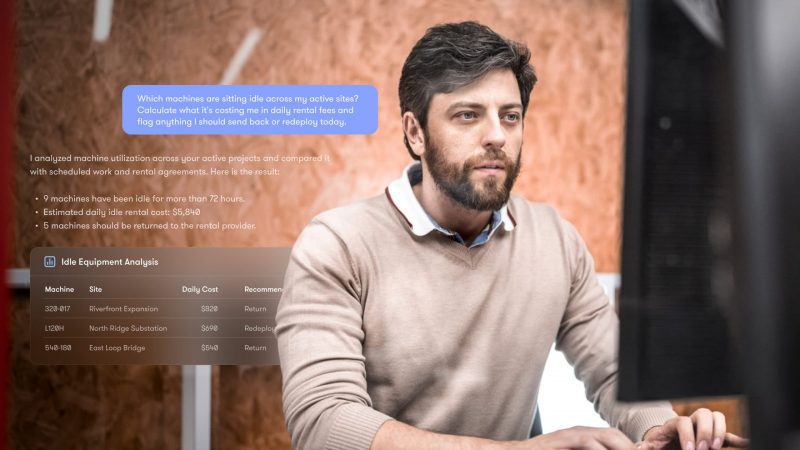
MCP is an open standard that acts as a universal bridge between AI and your core business systems. It enables an AI agent to reach into different software environments and pull the data it needs, when it needs it, to drive real workflows.
In construction terms, MCP lets AI securely connect systems like telematics, rental ERP, and maintenance platforms through a single interface, instead of building one-off, point-to-point integrations for each connection.
At Trackunit, we have built MCP into our ecosystem so that our customers’ AI tools can work directly with their Trackunit data. As teams interact with AI in their day-to-day operations, the data flows to them naturally — no custom integrations required.
“At Trackunit, we have built MCP into our ecosystem so that our customers’ AI tools can work directly with their Trackunit data.”
This is where platforms built for construction start to matter. MCP needs a data layer that already understands machines, workflows, and permissions. In practice, that means working on top of a construction operating data platform like Trackunit IrisX, where machine data, applications, and workflows are already connected and governed.
The real significance of MCP is that it significantly reduces the barriers between different systems. Barriers that have long inhibited the creation of new value across the construction and rental industries are disappearing.
Historically, getting two systems to interface and share data has been complex and fragile. Every integration was a bespoke project, expensive to build and difficult to maintain. That friction meant that valuable data stayed locked in silos, unable to contribute to better decision-making.
With MCP and an overarching AI layer, someone at a rental company can now easily connect their telematics data to their rental ERP — but that’s just the beginning. The technology makes it easy to combine data from fleet management, maintenance systems, customer platforms, and more, all through a single intelligent interface.
MCP gets the systems talking. But rental companies have another major opportunity to tap into: sharing assets with customers through AI.
This is one of the biggest unmet needs in the rental industry today. In conversations with contractors across the market, a consistent theme emerges: Customers want the rental companies they work with to share rented assets into the customer’s own fleet management system in a more systematic way.
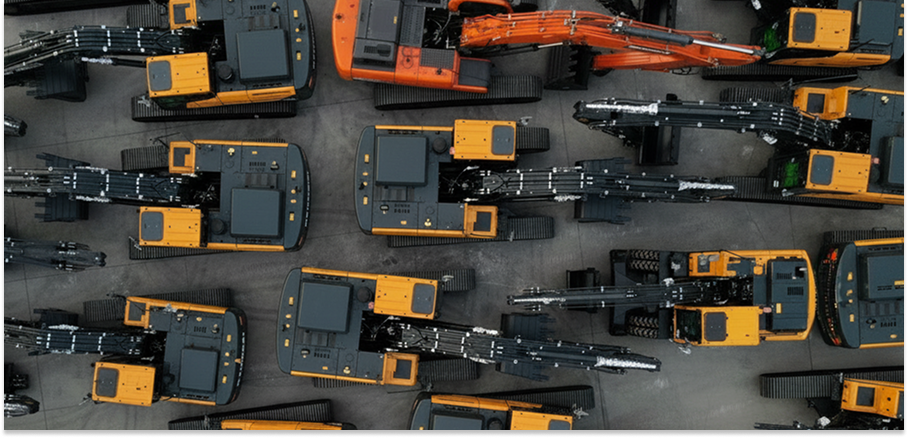
When a contractor rents a machine, they need visibility of that asset alongside the equipment they own, not in a separate silo. Through AI, rental companies can now automatically create customer sharing workflows that push rented machines into the customer’s fleet management platform as soon as they go out on rent
A process that was once a manual and inconsistent becomes seamless and automatic, strengthening the relationship between rental company and customer, and giving contractors the unified fleet visibility they have been asking for.
Another long-standing challenge is detecting when a customer operates outside the terms of their rental contract. For example, a machine rented for use in Switzerland turns up on a jobsite in Germany, exceeds its allocated hours, or is used outside agreed working hours. These are common scenarios in rental, and they carry real financial and liability implications.
In the past, monitoring for these violations required a person to read each rental agreement, interpret the terms, and then manually create software rules to flag breaches. It was labor-intensive, inconsistent, and almost impossible to scale across a large fleet.

Today, AI changes the equation entirely. An AI agent can read rental agreements, extract the relevant terms and conditions, and automatically apply rules that monitor whether a customer is operating within contract. When a violation is detected, whether it is geographic, temporal, or usage-based, the agent can immediately alert the appropriate people within the rental company.
Workflows that once required a team and a patchwork of manual processes can now run continuously and autonomously. When these workflows run on governed data within operational data platforms like IrisX, companies can control access and permissions, ensuring AI operates within existing security and compliance frameworks.
Another area where AI can create significant value for rental companies is fleet optimization. Through AI-driven analysis, a rental company can optimize not only the volume and type of machines in its fleet, but also their geographic distribution.
The inputs feeding these decisions can range from economic reports and market forecasts to telematics data and real-world machine usage patterns. And thanks to MCP, even data from customers’ own connected systems.
This represents a fundamental shift in how fleet decisions are made. Traditionally, fleet optimization has been a quarterly exercise, a periodic review that, by its nature, always lags behind the market. With AI, fleet management becomes a continuous process.
The analysis runs on an ongoing basis, constantly adjusting recommendations as conditions change. The result is a fleet that is right-sized and right-placed at all times. Rental companies can ensure that they never miss an opportunity due to undersupply, and at the same time, never find themselves overfleeted and carrying unnecessary cost.
When we step back and look at the bigger picture, AI is really acting on three distinct planes within the rental industry: Speed and continuity, integration across systems, and entirely new problem-solving capabilities.
The first is the plane of speed and continuity. Tasks that humans used to perform on a weekly, monthly, or quarterly basis (business optimization, fleet analysis, compliance monitoring) can now run continuously, with greater accuracy and at a fraction of the effort. The periodic review becomes a living process.
The second is the plane of integration. Complex system integrations have long held the industry back. Teams could not create valuable workflows because connecting systems was too difficult, too delicate, and too expensive to maintain. With AI and technologies like MCP, we can now work across systems seamlessly to build sophisticated workflows.
Those first two planes allow us to tackle existing problems in ways that are smarter and faster. The third plane goes further: AI enables us to solve problems that simply could not be solved before. Entirely new capabilities become possible, not incremental improvements, but genuinely new solutions to challenges the industry has never been able to address.
I invite you to think about AI across these three planes. Are you doing something better and faster? Are you working across systems? Or are you solving a new problem that could not be solved before?
The answer matters, because depending on which plane you are operating on, you may need a more or less rigorous development and change management plan. The further you move from optimization toward entirely new territory, the more thoughtful and deliberate your approach will need to be.
What is clear is that AI is not a single innovation with a single benefit. It is a fundamental shift that will reshape how rental companies operate, compete, and create value at every level of the business.
Technologies like MCP make that shift practical. They turn fragmented systems into connected workflows and make data usable in real time, which is ultimately what the industry has been working toward for years
Federico Rio is a 25-year veteran of construction having cut his teeth in the heavy equipment industry with Caterpillar. Specializing in machine design, digital & technology, and sales & marketing, he joined Trackunit in 2023 where he is Senior Vice President of Product and Pricing.