


– 10 min.
A blurry, black and white close-up showing faint curved lines or text below a dark upper background, related to construction IoT.

How can I build on top of my telematics data?

Telematics data becomes buildable once it is normalized across OEM brands into a single ​​governed and harmonized data layer. Without that layer, the data exists but cannot be acted on at scale.
A man with short gray hair and glasses, in a white shirt and black blazer, smiles indoors, representing construction IoT.
Mikkel Dalgas
CTO at Trackunit
Aerial view of a construction site with two large buildings and yellow cranes, showing efficient connected jobsite coordination.

IrisX is Trackunit’s Construction Operating Data Platform. It powers telematics and fleet management by transforming fragmented machine data into structured, AI-ready intelligence.


Why is telematics data alone hard to act on?

Most OEM digital teams face the same structural problem. Data exists across machine models, regions, and connectivity sources, but lands in separate systems with incompatible formats.

Engineers spend weeks cleaning and stitching that data before analysis can begin. By the time insights surface, product decisions have been made and service windows missed.

Most companies act on less than 10% of the data their machines generate. That figure comes from Trackunit’s experience across construction fleets globally. The gap is not sensor coverage. It is the layer between raw connectivity data and operational action.

For OEMs, the cost is strategic. Machines leave the factory and the data loop closes.

Telemetry feeds into portals that product engineers rarely access in a usable form. Service runs on calendar intervals instead of actual machine condition, and customer relationships thin between transactions.

Three dark panels show Machines, Ports, Attachments, and People merging into metrics linked to icons in a circle—fleet management concept.
Multi-source operating data flows into IrisX, where it is harmonized, construction context is applied, and made available across integrations and applications.

What new capabilities open once data is normalized?

Once machine data sits in a single governed environment, ​​best in class technological capabilities become immediately accessible. OEM partners ingest around 150 data points per machine into IrisX, across fleets of ten or ten thousand units.

Data arrives in a standardized form. Engineers stop cleaning it and start building on it.

The five categories are AI-native fleet access, service automation, cross-site utilization dashboards, custom alerts with out-of-contract detection, and AI-driven diagnostics. Each runs on the same underlying data layer.

How do I give my team AI-native access to fleet data?

Until recently, getting answers from fleet data meant navigating dashboards, exporting reports, and waiting for analysis. Most of that friction is now gone.

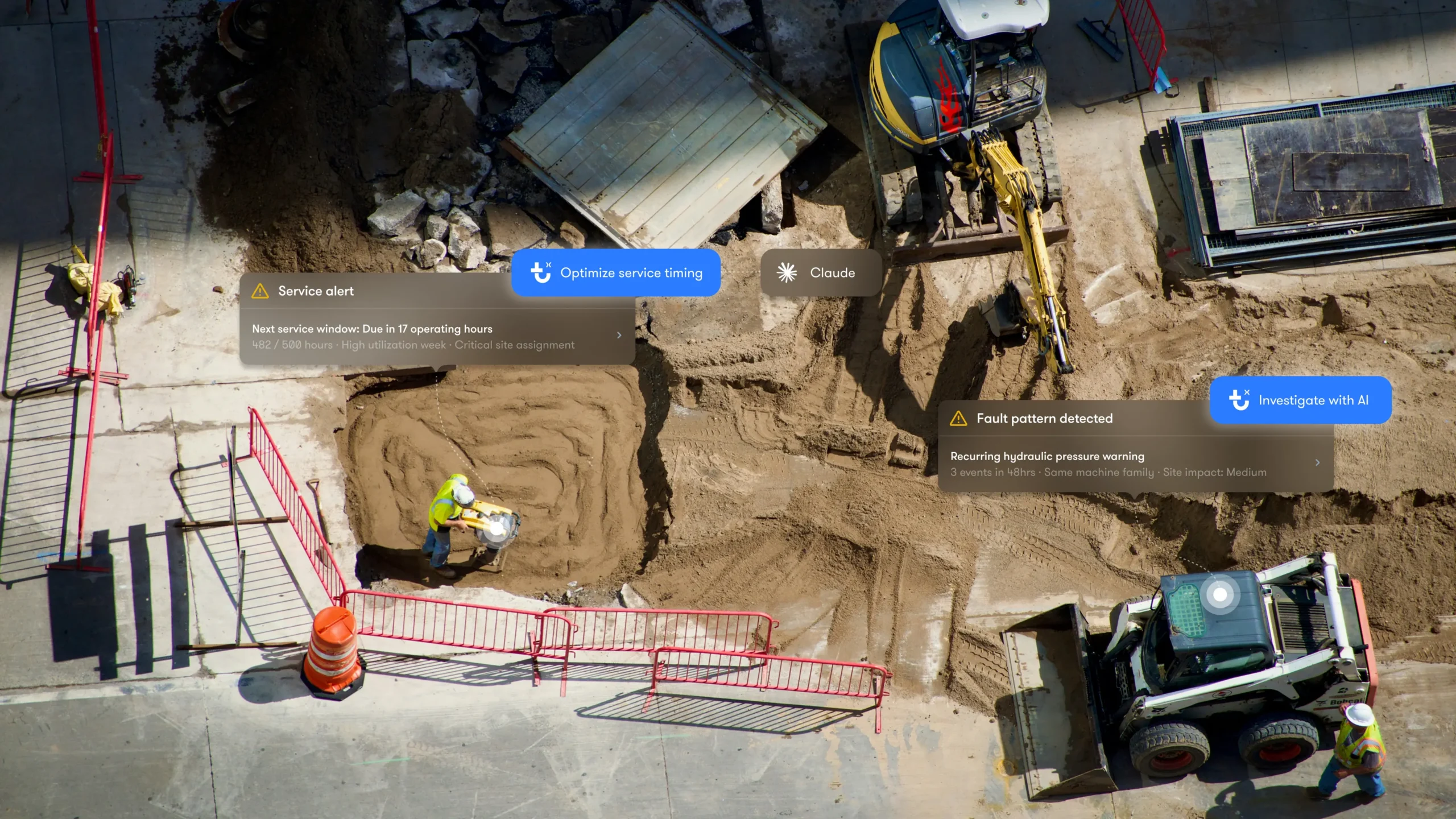
Trackunit IrisX MCP makes IrisX data accessible through any major AI client, including Claude, ChatGPT, and Microsoft Copilot. Fleet managers and developers can query assets, update metadata, and create alert configurations through natural language, with no dashboard required.

This is what the “can’t do today” framing in this article is really about. For the first time, fleet operators can query their machines directly from the AI tools they already use.

For daily fleet operators, the IrisX AI Assistant takes this further. It is a native chat interface embedded in Trackunit Manager, letting users ask questions and trigger actions without navigating menus.

Both are available to customers as part of the AI in IrisX initiative. Full documentation is at developers.trackunit.com.

How do I automate service scheduling from machine data?

Automated service scheduling triggers from actual machine events, not calendar intervals. When a machine returns to a depot, a webhook fires and kicks off a downstream workflow.

The workflow checks usage patterns, impact events, and rental period data. It generates an AI-written service summary.

A custom field in Trackunit Manager updates to “service needed.” The depot manager gets a notification with context on what to inspect next.

Rental companies using this approach cut machine turnaround time by up to 50%, based on Trackunit’s experience. A regional fleet of around 2,000 machines saved approximately $100,000 in annual labor cost.

A specialist fleet of 5,000 machines gained more than $1 million by getting assets back on rent faster. Both figures come from Trackunit’s experience with rental customers.

A leading rentals firm in the UK & Ireland built an analytics application on the Trackunit platform covering true fuel costing and utilization improvements. The application addresses key customer focus areas.

The underlying tool is Automation Studio, a no-code visual workspace inside IrisX. It connects triggers, data, and actions without requiring developers.

Webhook events available include fault codes, service management, alerts, and site entry. Technical documentation and the smart servicing blueprint are at developers.trackunit.com.

A network diagram with red dots as nodes, some labeled, on a light background—illustrating construction equipment tracking.
IrisX consolidates operating data from every connected machine, regardless of OEM brand, into one governed Data Lakehouse

How do I build cross-site utilization dashboards for a mixed fleet?

Mixed-fleet utilization is invisible when data lives in separate OEM portals. Each brand transmits to a different system in a different format.

Once data is in a single governed Data Lakehouse, utilization from every brand appears in one view. Teams can then compare duty cycles, payload patterns, idle time, and utilization rates across machine types and regions.

For OEMs, this changes how machines get designed. An average 10,000-machine OEM fleet saved approximately €2.5 million through reduced over-engineering, according to Trackunit research. That is around €250 saved per machine. Teams designing against actual field data over-specify less.

R&D cycles also shorten because field usage data is continuous and queryable. It is no longer locked in one-off analysis requests.

The data-driven product design blueprint in the Trackunit Marketplace provides a ready-to-deploy starting point.

How do I set up custom alerts without a development team?

Custom alerts start from webhooks and no-code automation recipes in Automation Studio, not development sprints. A theft alert fires when a machine leaves a site boundary. A billing reference auto-updates when an asset enters a subcontractor zone.

An out-of-contract flag creates a Salesforce task the moment overuse is detected. These are event-driven, not polling-based, so the notification arrives immediately rather than waiting on a polling cycle.

Trackunit research found more than $1.1 million in recoverable out-of-contract revenue across 4,500 machines over nine months. August alone showed more than $200,000 from IoT data only.

The out-of-contract usage blueprint provides a ready-to-deploy starting point for this workflow.

How do I add AI-driven diagnostics to my machines?

AI-driven diagnostics become possible when fault codes and usage patterns are clean, labeled, and consistent. Fragmented telematics from multiple OEM brands cannot meet that requirement on its own.

On a single governed data layer, fault codes from any machine trigger the same diagnostic workflow. An AI-written service summary translates connectivity events into plain language a technician can act on immediately.

For OEMs, this closes the loop on warranty performance. Early detection of abnormal usage lets engineering teams address issues before they escalate into replacement campaigns.

The battery management insights blueprint contributes to approximately $3 million in annual business impact for an average OEM fleet, according to Trackunit research. That covers warranty cost reduction, diagnostic revenue, and faster issue resolution.

IrisX processes 3 billion data points daily across more than 6 million connected assets. That scale, built on 20 years of construction-specific context, is what makes AI produce reliable results in the field.

Construction site dashboard showing equipment status, map location, fleet health, asset activity, and service alerts; construction IoT.
AI-driven diagnostics surface patterns that would be missed without fleet-scale data

How do I build and distribute a custom application on top of this data?

Custom applications for internal users or external customers are built using the IrisX App SDK. The SDK is a collection of tools, components, and guidelines available in the IrisX Developer Hub.

The workflow is repeatable: create an application, configure and brand it, then publish it to the Trackunit Marketplace. From there, it becomes accessible inside any customer’s branded portal immediately.

Blueprints provide the starting point. They are structured reference applications, around 80% complete, that teams clone and extend.

One Trackunit partner built an emissions insights application covering tens of thousands of machines in two days. Engineering teams had previously scoped that same build at two months.

One Trackunit OEM customer reached 10,000 customers with a branded portal in two weeks. That same OEM had previously spent three years on integration infrastructure with nothing to show for it. The IP belongs to whoever builds on top.

What does the build vs. buy decision look like for OEM digital teams?

Building data infrastructure on generic cloud is possible. It is slower and more expensive than it first appears.

Time to first customer value on a generic platform is typically 12 to 18 months. Between 60 and 80% of engineering resources on self-built platforms go toward keeping infrastructure current, based on Trackunit’s experience.

That leaves 20 to 40% for features that generate revenue. Around 70% of platform projects on generic cloud fail to deliver expected outcomes, according to Trackunit.

Building on an established operating data platform compresses time to first customer value to three to six months. OEM data integrations, ISO 27001 security certification, and AI-ready data standardization come included.

Aftermarket services carry operating margins approximately 2.5 times higher than new equipment sales, according to Deloitte. The OEMs capturing that margin are the ones with digital infrastructure to deliver proactive service at scale.

For a full cost comparison, see How do I evaluate a construction data platform: build or buy?

What capabilities does each path support?

Both paths allow full ownership of the product and application layer. The difference is how much engineering capacity actually reaches that layer.

Building each capability from scratch requires solving data normalization, governance, and integration before a single product feature ships. On an established operating data platform, those problems are already solved.

Capabilities and use casesStarting from scratchBuilding on an operating data platform
AI-native fleet accessRequires custom AI integration buildMCP Server ready, works with all major AI clients
Automated service schedulingCustom webhook and data pipeline build requiredAvailable via Automation Studio, no-code
Cross-site utilization dashboardOEM data normalization must be built per brandBlueprints ready to deploy from Marketplace
Custom alerts and integrationsCustom integration per external system1,200+ connectors, no-code recipes
AI diagnosticsClean data layer must be built first3B daily data points, 20 years of context included
Customer portalTypically 12 to 18 months average build timeDeployable in weeks via App SDK
IP ownershipYoursYours
Table: A comparison of starting from scratch against building on an established operating data platform

Want to see how the IrisX operating data platform can help you find a faster path to value? Book your demo

Frequently asked questions

What is the difference between telematics data and data I can build on?

Telematics captures and transmits raw machine signals. Building on that data requires a layer that normalizes those signals across OEM brands, governs them for security and compliance, and makes them available to analytics tools, AI models, and automation. That layer is what an operating data platform provides.

Can I access my fleet data through AI tools I already use?

Yes. The Trackunit MCP Server makes IrisX data accessible through Claude, ChatGPT, and Microsoft Copilot using the open MCP standard. Users can query assets, update metadata, and create alert configurations through natural language, with no dashboard required. It is available to all customers as part of the AI in IrisX initiative.

What types of applications can I build from machine data?

Service automation workflows, utilization dashboards, out-of-contract usage alerts, AI-driven diagnostics, data-driven product design tools, and branded customer portals are all in active deployment across Trackunit customers. Starting points for several of these are available in the Trackunit Marketplace as ready-to-deploy blueprints.

How do I start building without a large engineering team?

The starting point is a blueprint that handles data ingestion and initial logic. Teams clone it, adjust it for their use case, and publish it. Developer documentation and getting-started guides are at developers.trackunit.com.

Do I need all my machines connected before I can start?

No. Starting with a subset, such as a specific region or product line, is valid. Value comes from representative data for that subset. As more machines connect, insights become richer.

What APIs are available for building on machine data?

GraphQL, time series, rental, and custom fields APIs are all available. Webhooks cover fault codes, service management, alerts, and site entry events. More than 1,200 connectors cover external systems including ERP, CRM, and third-party platforms. Full API documentation is at
developers.trackunit.com.

How do I connect machine data to Salesforce, SAP, or other enterprise systems?

Automation workflows connect to external systems through Trackunit connectors and more than 1,200 ready-made integrations. An out-of-contract usage event can automatically create a Salesforce task without any manual steps. No custom integration build is required for supported systems.

Is my data secure when I build on top of it?

Data security is a structural property of the platform, not a feature added afterward. IrisX is ISO 27001 certified with end-to-end encryption. Each organization’s data remains in its own governed environment. No AI model trains on customer data, according to Trackunit.

How do I distribute what I build to my customers?

Applications built on IrisX publish to the Trackunit Marketplace. From there, they are accessible inside a customer’s branded portal under the OEM’s brand, without the OEM building or maintaining separate backend infrastructure.

How long does it take to go from raw machine data to a working application?

With a blueprint as a starting point, teams have built and deployed working applications in days. One emissions insights application covering tens of thousands of machines was built in two days. A custom application from scratch, with data infrastructure in place, typically takes three to six months to first customer value.

What do I need in place before I can start building?

The main prerequisite is connected machines. If telematics devices already transmit data from the fleet, an operating data platform can ingest and normalize it from day one. Access to IrisX is required to use Automation Studio, the App SDK, and the blueprints in the Marketplace

What is an IrisX blueprint in simple terms?

A blueprint is a structured application built around a specific business problem, already around 80% complete. Teams use it as-is or extend it. Examples include smart servicing, battery management insights, data-driven product design, and out-of-contract usage detection.

How do I protect my IP when building on a shared platform?

What a team builds on top of IrisX belongs to that team. The data model, algorithms, and application logic are owned by the organization that creates them. The platform provides the infrastructure layer. The competitive differentiation sits in the product and application layer, and that layer is entirely the builder’s own.

About the author

Benoît Guibert is a Product Marketing Manager for IrisX at Trackunit, focused on turning construction data into practical, real-world solutions. He brings experience across SaaS, cloud, and digital platforms, helping translate complex technology into clear business value.

Sign up for the Trackunit newsletter

Never miss an insight. We’ll email you when new articles are published on this topic.

Today people are reading

Construction Library, IrisX
– 7 min.
A small, blurry section of an image with a black and white rectangular shape and curved lines, possibly related to construction IoT.
Trackunit Live

What's new. Join the quarterly product update

Join Trackunit for a 30-minute live session and get a clear overview of the Trackunit roadmap, including recent releases and what’s coming next.