





IrisX is Trackunit’s Construction Operating Data Platform. It powers telematics and fleet management by transforming fragmented machine data into structured, AI-ready intelligence.
The decision is not primarily about technology. It is about where engineering hours create the most competitive value.
If the data platform is the core product, a proprietary architecture may make strategic sense. However, for most OEMs, rental companies, and contractors, the competitive advantage is the equipment built or the service delivered.
Every infrastructure engineering hour is one not spent on that differentiator. The decision deserves an honest evaluation.
Building on generic cloud is slower and more expensive than it first appears. Time to first customer value typically runs 12 to 18 months on a generic platform, based on Trackunit customer data.
In that window, AI capabilities advance and market conditions shift. Capital is consumed before a single customer benefits.
The maintenance burden is the less visible cost. Once built, a platform requires constant upkeep: security patches, data model updates, and scalability work.
Between 60 and 80% of engineering resources on self-built platforms go toward keeping infrastructure current, based on Trackunit customer data. That leaves 20 to 40% for features that generate revenue.
OEM data integration adds further sustained cost. Construction operating data comes from dozens of brands, each with different telematics formats and update cycles.Every new OEM brand added to the fleet requires engineering effort. That cost compounds in ways that are easy to underestimate at the start.
Security and compliance carry their own burden. Building ISO 27001 certification, end-to-end encryption, and data lineage tracking from scratch is a multi-year investment. These are not features to add later. They are structural properties that a trusted platform requires from day one.
Around 70% of platform projects built on generic cloud fail to deliver expected outcomes, based on Trackunit customer data. The most common failure modes are underestimated maintenance burden and OEM integration complexity.
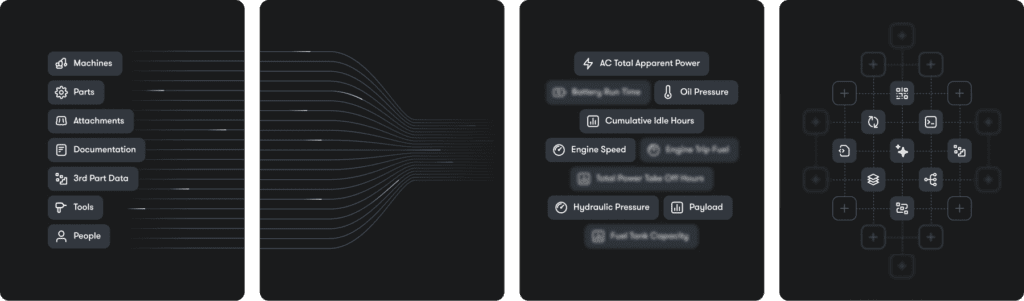
Building on an industry cloud platform transfers infrastructure cost to the platform. Engineering effort then concentrates on the layer where competitive differentiation actually happens.
Time to first customer value compresses to three to six months. OEM data integrations are already maintained by the platform, so teams skip that build entirely.
AI readiness is built in from day one, because data standardization and governance work is already done. Security certification is a property of the platform, not a milestone to reach independently.
The shared maintenance model changes the economics over time. Infrastructure cost is distributed across hundreds of organizations rather than carried by one team.
Aftermarket services carry operating margins approximately 2.5 times higher than new equipment sales, according to Deloitte. Capturing that margin requires digital infrastructure that delivers proactive service at scale.
One Trackunit OEM customer deployed 10,000 branded customer portals in two weeks. That same customer had spent three years on SSO layers and integration infrastructure with no deployment to show for it.
Two weeks versus three years is not a cost difference. It is a different category of outcome entirely.
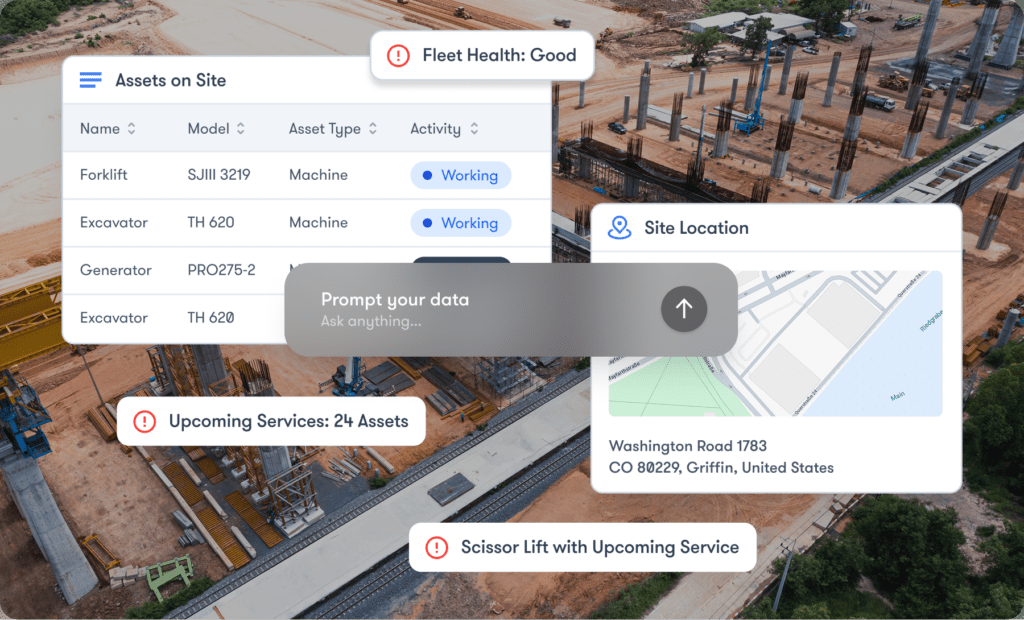
Both paths allow full ownership of the product layer. The difference is how much engineering capacity actually reaches it. The table below shows how the paths diverge across the dimensions that matter for construction.
| Build on generic cloud | Build on Trackunit’s industry cloud platform | |
|---|---|---|
| Time to first customer value | 12 to 18 months | 3 to 6 months |
| Engineering overhead | 60 to 80% on infrastructure | Low: infrastructure already exists |
| OEM data integration | Must build and maintain per OEM | Included and maintained |
| AI readiness | Requires data pipeline work first | Ready from day one |
| Security and compliance | Must build independently | ISO 27001 certified, end-to-end encryption |
| Customization | Full control of all layers | Full control of product and application layer |
| Long-term maintenance | All updates are your responsibility | Shared across the platform community |
| Project risk | Around 70% fail to deliver | Proven at scale across OEMs, rental, contractors |
A proprietary platform makes sense in a narrow set of situations. The strongest case is when the data platform is the core product, not the infrastructure behind a service.
A large engineering team with a long investment horizon is also required. Without that, maintenance burden will consume the program before it delivers.
It makes less sense when the core competency is manufacturing equipment, providing rental services, or delivering construction projects. Speed to market and early-stage programs are also signals to build on an established platform rather than starting from scratch.
The build vs. buy framing implies a binary choice. In practice, the most effective approach is hybrid: buy the infrastructure layer and build competitive advantage on top.
An industry cloud platform provides the data lake, governance, security, and integration infrastructure. Organizations build branded customer portals, proprietary analytics models, and custom workflows on top using standard APIs and an app SDK.
The IP belongs to whoever builds on top. One Trackunit partner built an emissions insights application covering tens of thousands of machines in two days.
The same build had previously been scoped at two months of development sprints. The platform handled the data infrastructure while the partner focused entirely on the application.
That is the practical outcome of the hybrid approach: engineering effort concentrates where it creates customer-facing value.
The upfront build is only part of the cost. Between 60 and 80% of engineering resources on self-built platforms go toward keeping infrastructure current, based on Trackunit customer data. OEM data integration, security certification, and scalability work all add sustained cost that compounds over time.
For OEMs, rental companies, and contractors, using an established platform is almost always faster, cheaper, and lower risk. Around 70% of self-built platform projects fail to deliver expected outcomes, based on Trackunit customer data. The most common cause is maintenance burden consuming the engineering capacity meant for customer-facing features.
The primary risk is maintenance burden consuming the engineering capacity intended for customer value. The failure is rarely visible until the engineering budget is already spent.
Yes. Branded portals, analytics models, and custom workflows are built by the organization using standard APIs and an app SDK. The IP belongs to whoever builds on top of the platform, not to the platform provider.
The ROI calculation starts with what the data could be doing, not with the platform cost itself. Compressing time to first customer value from up to 18 months down to three to six months is one measure. Aftermarket services also carry operating margins approximately 2.5 times higher than new equipment sales, according to Deloitte.
Existing telematics stays in place. A construction data platform ingests data from those systems and adds standardization and governance on top. Nothing in the existing connectivity layer needs to be replaced.
If 60 to 80% of engineering capacity is going toward infrastructure maintenance, little remains for customer-facing features. Most teams cannot sustain that ratio, which is why most self-built programs fail before they deliver value.
Building on generic cloud typically takes 12 to 18 months to first customer value, based on Trackunit customer data. An industry cloud platform reduces that window to three to six months. The difference is the time required for data modeling, OEM integrations, and connecting to existing business systems.
Ready-to-deploy starting points activate against live fleet data already in the platform, with no separate data preparation required. Teams can start with a single use case and expand from there.
A platform scales from a single use case to a full digital operations layer. Organizations start with what fits current needs and expand without rebuilding infrastructure each time. The product built on the platform, and the IP within it, remains entirely owned by the organization.
Mikkel Dalgas is Chief Technology Officer at Trackunit. He leads the architecture and development of IrisX, Trackunit’s Construction Operating Data Platform. With extensive experience in cloud infrastructure and enterprise data systems, he has focused on building secure, scalable, construction-specific platforms that unify operating data across OEMs, rental companies, and contractors.