




Why does construction need an Operating Data Platform? Construction generates more equipment data than almost any other industry. Most of that data never gets used. The problem is not a lack of data. It is a lack of infrastructure to connect it.
In Trackunit’s experience, working across construction fleets globally, most companies act on less than 10% of the data their equipment generates. The rest is captured and stored, but never harmonized, never governed, and never connected to systems where it changes decisions.
A Construction Operating Data Platform fixes this. It sits above individual telematics systems and turns disconnected equipment data into a single, harmonized, governed foundation that every downstream application can build on: analytics dashboards, automated workflows, AI models, and customer portals.
IrisX is Trackunit’s Construction Operating Data Platform. It powers telematics and fleet management by transforming fragmented machine data into structured, AI-ready intelligence.
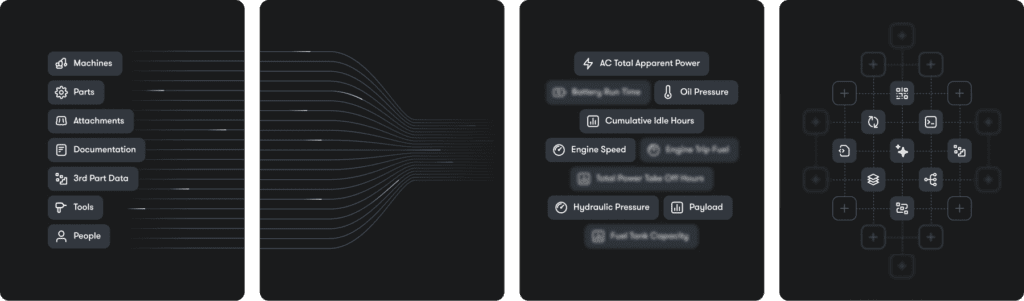
A Construction Operating Data Platform is a data infrastructure layer purpose-built for construction operating data. It ingests equipment telemetry, utilization records, fault codes, rental contract data, inspection records, site events, and enterprise data from ERP, CRM, and project management systems, and makes all of it usable.
Every true Construction Operating Data Platform does four things:
1. Ingests data from every source: OEM telematics, IoT devices, third-party systems, and enterprise platforms, regardless of format or origin.
2. Harmonizes it: normalizing different OEM data formats into a common data model so a utilization metric from one brand means the same thing as a utilization metric from another.
3. Governs it: applying security controls, data lineage tracking, access management, and compliance frameworks so data can be trusted and shared safely.
4. Activates it: making harmonized data available to analytics tools, AI models, automation workflows, custom applications, and integrations through open APIs.
Together, these four capabilities turn fragmented machine and business data into an AI-ready foundation for the entire construction ecosystem.
This is what distinguishes a Construction Operating Data Platform from fleet management software. Fleet management software uses data. A Construction Operating Data Platform structures and governs it, so every system downstream builds on a shared foundation without rebuilding the infrastructure.
For a deeper look at the technical architecture, read: What is a construction operating data platform and how it powers telematics
This table shows how the three layers work together. Telematics is the data collection layer. Fleet management is the workflow layer built on top of harmonized data. The Construction Operating Data Platform governs and orchestrates both.
| Construction Operating Data | Telematics Platform | Fleet management software | |
|---|---|---|---|
| Purpose | Ingests, harmonizes, governs, and activates all construction operating data | Captures and transmits machine data | Reports, schedules, and manages workflows |
| Designed for | Off-road construction equipment, mixed OEM fleets, and jobsites | Machine-level data collection | Operational visibility and maintenance scheduling |
| Data handling | Normalizes data across OEM brands into a common model | Transmits raw machine data to a portal | Uses pre-formatted data from a single source |
| Governance | ISO 27001 certification, data lineage, access controls, and compliance | Minimal | Minimal |
| AI readiness | AI-ready data lake supporting ML models, agents, and natural language queries | Not designed for AI | Not designed for AI |
| Scope | Foundation for all downstream systems | Data collection layer only | Workflow layer only |
Telematics gave fleet managers their first real-time window into machine performance. Location, hours, fault codes: the fundamentals of visibility. That was genuinely transformational. But construction’s data needs have grown beyond what telematics was designed to handle.
Telematics captures data at the machine level and transmits it to a central system. What happens after it arrives, how it gets cleaned, normalized, stored, governed, and made accessible to other systems, is outside the scope of telematics.
The gap between “we have telematics data” and “we can act on our data” is precisely where a Construction Operating Data Platform lives. It is not a replacement for telematics. It is the layer that makes telematics data usable at scale: across multiple OEM brands, across multiple business systems, with the governance enterprise operations require.
Trackunit IrisX sits above telematics systems as the Construction Operating Data Platform, ingesting operating data from every source regardless of origin. IrisX streamlines, harmonizes, normalizes, and labels that data, and stores it in a common data lake, making it ready to be used across systems or for analytics.
Once operating data is harmonized and governed, it unlocks capabilities that fragmented telematics cannot support.
AI and machine learning at fleet scale: AI models require clean, consistent, labeled data. Fragmented telematics from multiple OEM brands makes AI projects extremely difficult to execute reliably.
A Construction Operating Data Platform creates the foundation AI requires. With a governed operating data platform, organizations gain a mature, elevated starting point for AI and machine learning technologies.
Cross-brand utilization analytics: Without harmonization, comparing utilization across OEM brands means comparing incompatible metrics. With a Construction Operating Data Platform, a single dashboard aggregates data from every machine in a mixed fleet, without custom data engineering for each new brand.
Automated service workflows: Automation requires reliable event triggers. When a machine generates a fault code, IrisX can automatically notify the right technician, update the service record, and initiate a parts order, without manual intervention.
Branded customer portals and aftermarket revenue: Aftermarket services carry operating margins approximatel 2.5 times higher than new equipment sales, according to Deloitte. In practice, that means significantly higher profit per service dollar than selling new machines. The OEMs capturing that margin are the ones with digital infrastructure to deliver proactive service. A Construction Operating Data Platform provides that foundation.
Integration across enterprise systems: ERP platforms, dealer management systems, CRM tools, and project management software all need equipment data. A Construction Operating Data Platform provides standardized integration pathways through open APIs and more than 1,200 prebuilt connectors, so data flows where needed without custom engineering per integration.
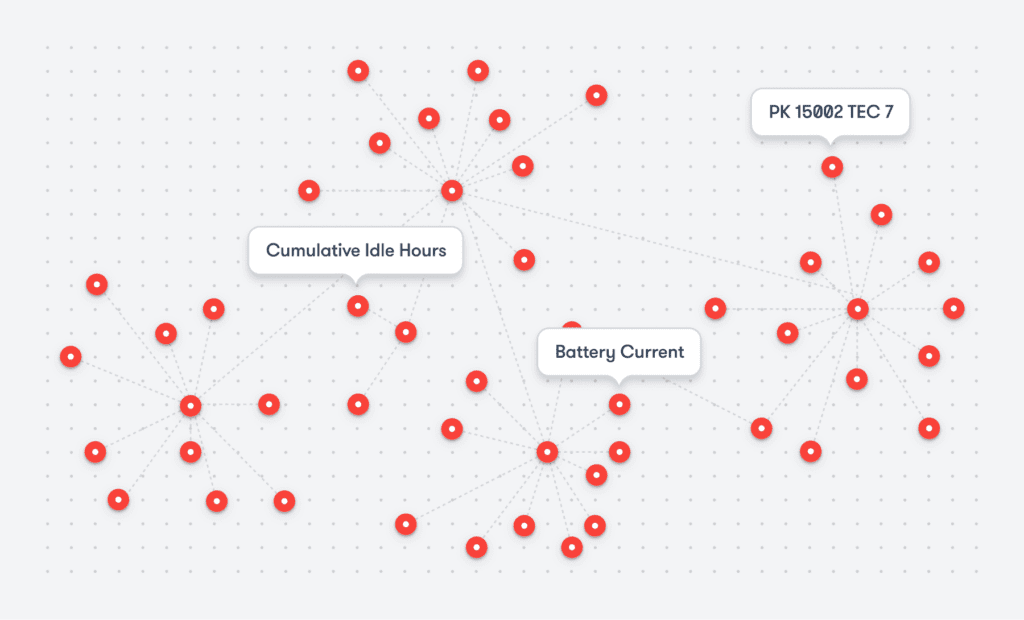
Construction has unique characteristics that make the data challenge more acute than in any other asset-intensive industry, and that make a generic platform insufficient.
Asset heterogeneity: No other major industry operates such a wide mix of equipment types, brands, and vintages at the same time. A single contractor may run machines from ten different manufacturers on one project. Normalizing that data is not optional. It is a prerequisite for any fleet-level analysis.
Ecosystem complexity: Construction projects involve OEMs, dealers, rental companies, contractors, subcontractors, and owners. Each has different data needs and a different relationship with the equipment. A Construction Operating Data Platform provides the shared data infrastructure that makes ecosystem-wide workflows possible.
Data volume growth: Construction operating data is scaling from millions to billions to trillions of records as connectivity rates increase. Building the infrastructure to optimize for those data volumes and make it available in real time is an enormously complex engineering challenge. Starting on an established platform significantly reduces that burden.
AI readiness is not optional: The construction companies that benefit most from AI are the ones with clean, governed, accessible operating data today. A Construction Operating Data Platform is the prerequisite for AI that works reliably in the field, not just in a proof of concept.
The industry cloud platform layer: A Construction Operating Data Platform is the data foundation. An industry cloud platform builds on that foundation to add AI and machine learning, automation studio, app SDK, marketplace, and branded portal capabilities.
IrisX is both. That distinction matters because it determines what you can build on top: not just dashboards and reports, but complete digital products delivered to customers.
The IrisX Construction Operating Data Platform is purpose-built for off-highway equipment operating data. It sits above telematics systems, fleet management software, and enterprise applications, unifying, governing, and making construction equipment data usable across all of them. The platform is built on a secure, scalable, and interoperable foundation.
Secure, so security and compliance teams can trust equipment data at scale. IrisX is ISO 27001 certified with end-to-end encryption. Security architecture must be foundational, not retrofitted. In the data center and cloud infrastructure world, cybersecurity and data privacy have to be the primary design goal from day one. Trackunit built IrisX on that principle.
Scalable, so organizations do not have to build and tune big-data infrastructure themselves. IrisX is optimized for the data patterns and query requirements that construction operating data demands at trillion-record scale. Generic platforms require organizations to solve this independently at sustained engineering cost.
Interoperable, so construction companies can connect the platform to any system in their stack. IrisX provides open APIs, a software development kit, and more than 1,200 prebuilt integrations and connectors so OEMs, technology partners, and customers can extend the platform without custom development.
Companies building on IrisX can cut approximately 80% of the platforming work needed to reach actual customer value. Around 70% of platform projects built on generic foundations fail to deliver their expected outcomes. Starting on an established, proven platform eliminates most of that risk.
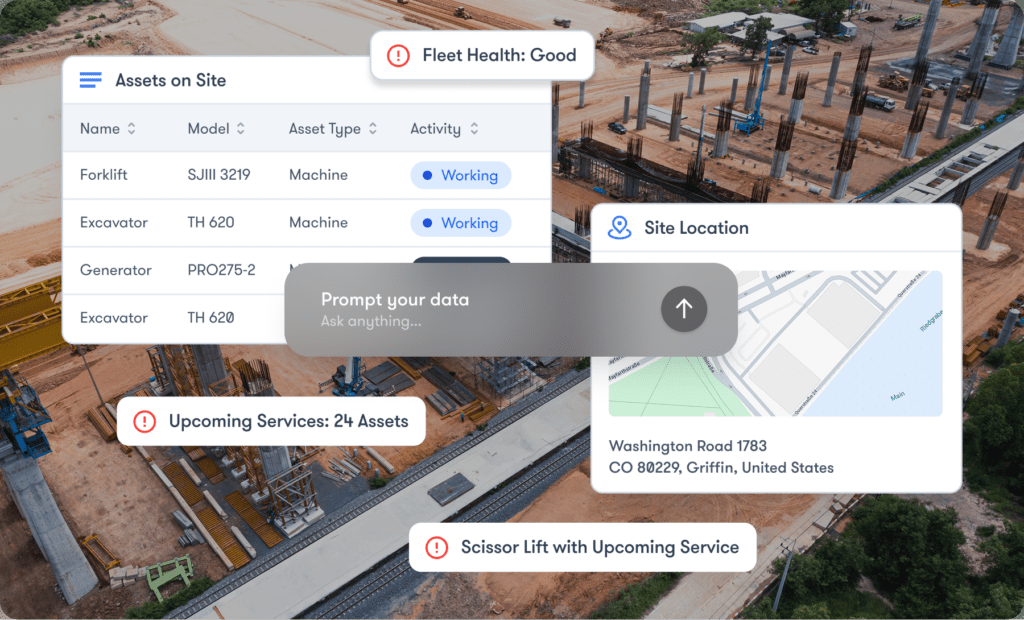
Here is how OEMs, rental companies, and contractors use IrisX to turn equipment data into business outcomes.
For an OEM: Telemetry from connected machines flows into incompatible portals, making proactive service and branded digital experiences impossible to scale. IrisX harmonizes all machine telemetry into one data model, flags fault codes before failures occur, and feeds real-world usage data back to product engineers. The result: customers get a branded portal built on the same data foundation, without the OEM building or maintaining separate backend infrastructure.
For a rental company: Utilization data from multiple OEM portals has to be reconciled manually, and out-of-contract usage and idle assets go undetected. IrisX pulls all utilization data into one place, flags out-of-contract usage automatically, and surfaces idle machines for redeployment. Revenue leakage is recovered and fleet decisions are made from a single governed view rather than multiple disconnected portals.
For a contractor: Fleet tracking, project management, and ERP run in separate systems with no shared data layer. IrisX unifies machine utilization, site activity, and project data into one governed dashboard. Site managers and operations teams work from a single view instead of switching between systems, and fleet deployment decisions are grounded in actual site data.
A Construction Operating Data Platform is best suited to organizations that operate mixed fleets from multiple OEM brands, need cross-fleet analytics and AI readiness, and require enterprise integration across systems like ERP, CRM, and dealer management software.
That typically means OEMs managing connected machine fleets and building digital aftermarket services, rental companies running multi-brand fleets, and large contractors operating across multiple jobsites.
It is less suited to small on-road delivery fleets focused on routing and ELD compliance, or single-OEM operations with no cross-system data requirements.
A Construction Operating Data Platform is a data infrastructure layer that ingests, harmonizes, governs, and activates operational data from multiple sources across construction equipment, OEM brands, and enterprise systems. IrisX is Trackunit’s Construction Operating Data Platform, purpose-built for off-road construction fleets.
Construction has characteristics that make a generic data platform insufficient: mixed fleets from multiple OEM brands generating data in incompatible formats, complex contractor and rental ecosystems, off-highway equipment outside standard IoT frameworks, and AI requirements that demand clean, normalized data at scale. A Construction Operating Data Platform is purpose-built to address all of these. Learn more
Telematics captures and transmits equipment data (location, hours, fault codes) from machines to a central system. A Construction Operating Data Platform sits above telematics, harmonizing that data across OEM brands, connecting it to enterprise systems, and governing it for security and compliance. Telematics is the data collection layer. A Construction Operating Data Platform is the layer that makes data usable across every system that needs it
Construction companies operate mixed fleets from multiple OEMs, each generating data in incompatible formats. Without a platform to harmonize that data, cross-fleet analytics, AI, and automation are extremely difficult to execute. Most construction companies use only a fraction of the data their equipment generates. A Construction Operating Data Platform is what changes that.
A Construction Operating Data Platform handles machine telemetry (location, utilization, fuel, fault codes), OEM diagnostic data, rental contract records, inspection and safety events, site activity data, and enterprise records from ERP, CRM, and project management systems. It ingests, normalizes, and governs all of it.
No. Fleet management software uses data for operational reporting, maintenance scheduling, and visibility dashboards. A Construction Operating Data Platform governs and structures the underlying data, enabling fleet management software, AI tools, dashboards, and custom applications to all build on a shared foundation without each rebuilding the data layer independently.
A true Construction Operating Data Platform does four things a fleet management system does not. It normalizes data across OEM brands into a consistent common model. It governs data with security controls and compliance frameworks.
It makes that data available to any downstream system through open APIs. And it is purpose-built for the data patterns and scale of off-highway construction equipment. Fleet management software is built to display and act on data. A Construction Operating Data Platform is the governed data foundation that fleet management software, AI tools, and other applications build on.
Yes. IrisX ingests data from existing telematics systems, including OEM telematics feeds from multiple brands, through the Trackunit Marketplace and Data Feeds capability. You do not need to replace your existing telematics infrastructure. The Construction Operating Data Platform adds the harmonization, governance, and integration layer on top of what you already have.
IrisX is Trackunit’s Construction Operating Data Platform, an industry cloud platform built specifically for off-highway equipment operating data. It provides a unified data lake, AI and machine learning capabilities, an automation studio, open APIs, an app SDK, and ISO 27001-certified security. IrisX enables OEMs, rental companies, and contractors to build digital operations on a shared, governed construction data foundation.
Mikkel Dalgas is Chief Technology Officer at Trackunit. He leads the architecture and development of IrisX, Trackunit’s Construction Operating Data Platform. With extensive experience in cloud infrastructure and enterprise data systems, he has focused on building secure, scalable, construction-specific platforms that unify operating data across OEMs, rental companies, and contractors.