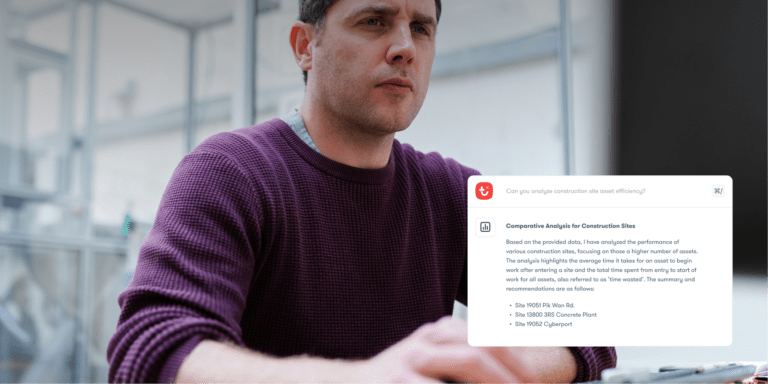






Glimpses of the future often tease, rarely satisfy, and frequently leave customers frustrated by a vision that feels unlikely and makes little practical difference to their daily business. But at Trackunit Next, two of the global contech’s leading AI experts laid out a pathway for construction businesses that not only spoke to the vision, but also to how Trackunit IrisX could make an exponential difference today to their whole business model.
In a joint presentation, Trackunit chief technology officer Mikkel Dalgas and vice president of field engineering Leo Fricke laid out how IrisX — Trackunit’s AI-powered platform — had already moved from promise to practice marking the completion of a journey that began at its launch in the sxecond half of 2024.
Their message was clear: artificial intelligence in construction had crossed a threshold. What once felt experimental was now delivering tangible operational impact.
“2026 is the year where AI leaves the incubation stage,” Dalgas said. “It moves from being exciting future talk to something that is here and now, delivering real business value.”
Rather than positioning AI as a standalone innovation, Dalgas framed Trackunit IrisX as a multiplier, accelerating innovation, productivity, and day-to-day optimization simultaneously. He described this as a “triple uplift,” driven by the convergence of data scale, conversational interfaces, automation, and system extensibility.
‘2026 is the year where AI leaves the incubation stage. It moves from being exciting future talk to something that is here and now, delivering real business value.’
“When you’re running on a mature platform with strong AI capabilities, your ability to innovate goes way up,” he said. “The time to implement, experiment, and bring things into production goes way down. That drives productivity, and it allows you to optimize the everyday business.”
At the heart of Trackunit IrisX is the reality that modern construction fleets generate vast quantities of data. Millions of connected assets stream billions of data points every day, far more than humans can meaningfully process without assistance.
“The bottleneck is no longer collecting data,” Dalgas said. “The bottleneck is reasoning over that data in real time, and acting on the few data points that actually matter.”
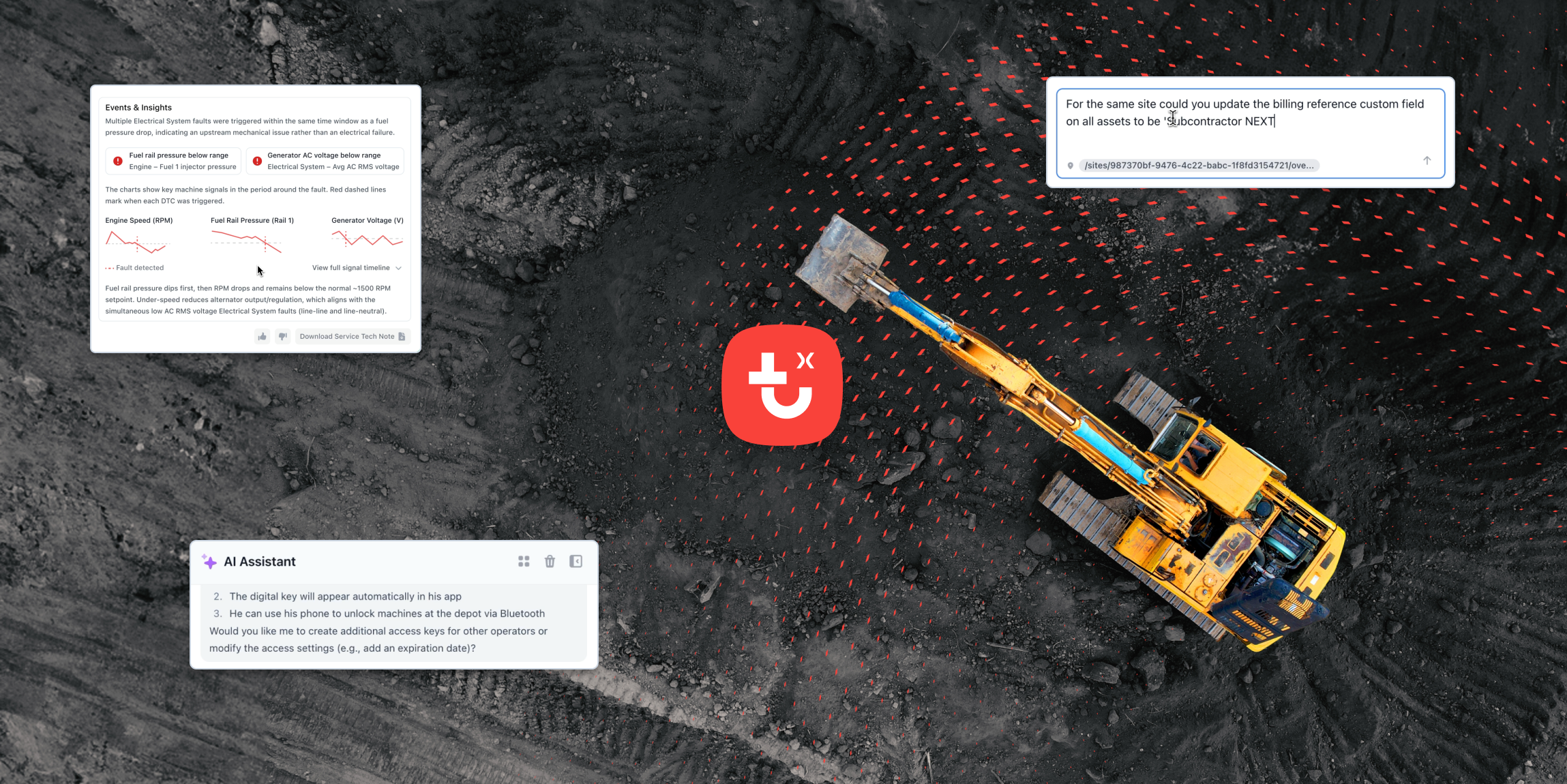
Fricke demonstrated how IrisX applied AI directly at the edge, analyzing machine behavior, sensor data, and fault codes to provide technicians with context, prioritization, and recommended actions.
“Machines create a lot of data and a lot of error codes, often without a clear root cause,” Fricke said. “Technicians are dispatched into the field with incomplete context. That’s where IrisX makes a difference.”

Instead of presenting raw alerts, the operating data platform surfaced likely causes, severity indicators, and estimated downtime. It also analyzed sensor behavior before and after faults to identify anomalies and suggest next steps.
“What you get is not just an alert,” Fricke said. “You get a possible cause, an indication of how severe the issue is, and recommended actions, all before the technician even arrives.”
For Dalgas, this marked a fundamental shift in the role of software. “IrisX is beyond monitoring,” he said. “It’s actively supporting decision-making in the field.”
Beyond diagnostics, the session focused heavily on usability. Dalgas said that traditional enterprise software limited value by forcing users through rigid interfaces and complex menus.
“Most of us use maybe 10% of the software we buy,” he said. “Not because the rest isn’t valuable, but because we don’t have the time or mental capacity to learn it.”
‘What you get is not just an alert. You get a possible cause, an indication of how severe the issue is, and recommended actions, all before the technician even arrives.’
Conversational AI, he said, changed that dynamic entirely.
“What AI brings is a conversational interface,” said Trackunit’s chief product officer. “It allows us to go beyond the user interface and engage with systems through conversation instead. That’s what turns people into super users.”
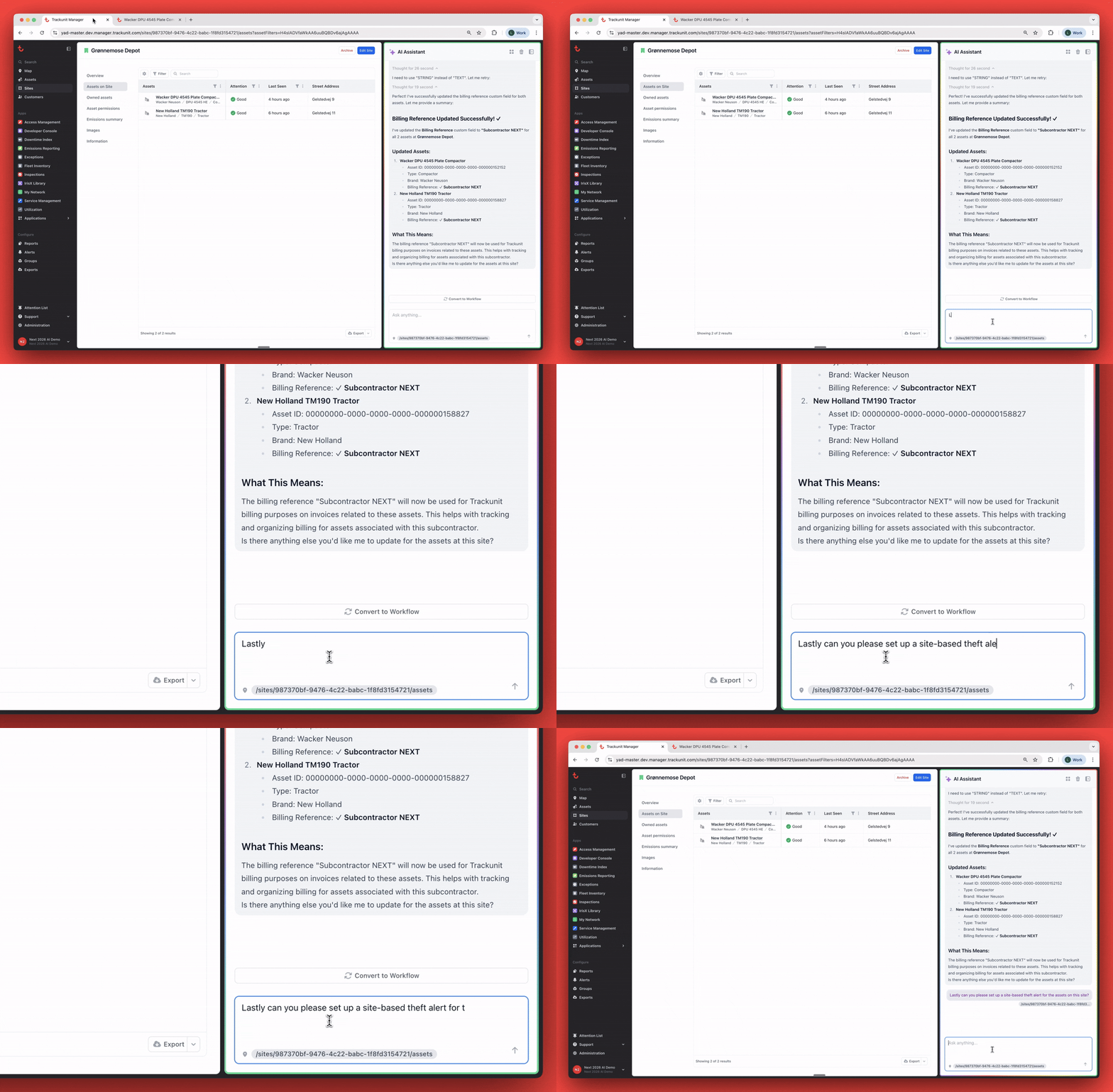
Fricke demonstrated how users could query fleet status, check upcoming service needs, grant site access, populate billing references, or configure theft alerts, all using natural language.
“These are things people do every day,” Fricke said. “But they’re manual, time-consuming, and error-prone. With IrisX, you just state your intent, and the system executes.”
In one example, Fricke showed how a site manager could generate digital access keys for machines, automatically notify operators, and verify permissions, all within minutes.
“Just think about how much we got done in three or four minutes,” he said. “That’s what being a super user looks like.”
The conversation then moved from one-off actions to repeatable work. Dalgas described automation as the natural extension of conversational interaction.
“Once you can describe intent in plain language, the next step is letting the system do it for you continuously,” he said.
Fricke showed how AI agents within IrisX could handle recurring workflows, such as enrolling assets into site-based theft alerts or updating billing references based on geofencing and GPS location.
“These agents run in parallel, all the time,” Fricke said. “They don’t need supervision, and they don’t stop working when you leave your desk.”
For Dalgas, this shift had cultural as well as technical implications.
“This moves automation away from something that happens in an IT department somewhere,” he said. “It becomes something every one of us can use to automate work and improve productivity every day.”
A major theme of the discussion was interoperability. IrisX is built around MCP (Model Context Protocol), which allows AI agents to securely access data and tools across systems.
“Everything you’ve seen so far is MCP-based,” Dalgas said. “We’re simply using our own IrisX MCP internally — and in 2026, we’re making that available across your entire IT stack.”
Fricke demonstrated how IrisX intelligence could be accessed directly from third-party AI tools such as ChatGPT or Claude, including on mobile devices.
“That means whether you’re in the yard, on the shop floor, or in the field, IrisX operational intelligence is available in your pocket,” he said.
Different large language models produced different analytical styles, Fricke said, but all drew from the same underlying operational data.
“The result isn’t just insight,” he said. “It’s flexibility. The ability to meet users where they already are.”

For Dalgas, this erosion of system boundaries had deep architectural implications.
“It fundamentally changes how we think about enterprise architecture,” he said. “Your data, your tools, your capabilities are no longer locked into one system.”
The final section of the session focused on development itself. Dalgas revealed that Trackunit had exposed Trackunit IrisX’s software development kits, design systems, and internal documentation through MCP — enabling AI-assisted application building.
“We’ve taken all the knowledge our teams use to build IrisX,” he said. “And we’ve made it accessible through the same conversational interface.”
Fricke demonstrated how a custom “asset cockpit” application could be built and deployed simply by describing the desired outcome.
‘This isn’t just about developers. It’s about enabling anyone — technical or not — to extend the system and create value.’
“The AI agent just gets to work,” he said. “You go from idea to a running application in minutes.”
The implications, Dalgas said, extended well beyond engineering teams.
“This isn’t just about developers,” he added. “It’s about enabling anyone — technical or not — to extend the system and create value.”
As the session closed, both speakers returned to the same central theme: responsibility.
“AI doesn’t change what value is,” Dalgas said. “It changes how we create it.” Speed, he added, was now decisive. “The faster you can build, the faster you can learn,” he said. “That pace of experimentation is what will set companies apart.”
For Fricke, the transformation was already visible in customer interactions.
“We’re not talking about the future,” he said. “This is how teams are working today.”
Together, their message was unambiguous. IrisX was no longer an experiment or a vision slide. It was an operational platform — one designed to turn AI from hype into habit, and from possibility into measurable performance.
Want to know more? Discover what Mikkel, Leo and our other experts had to say in full at Trackunit Next here.